

As a supplier of Chain Jacquard Machines, one of the most frequently asked questions I encounter is about the space requirements for these remarkable pieces of equipment. Understanding the space needed for a Chain Jacquard Machine is crucial for textile manufacturers, as it directly impacts factory layout, workflow efficiency, and overall operational costs. In this blog post, I'll delve into the factors that determine the space requirements of a Chain Jacquard Machine and provide some practical insights to help you plan your factory space effectively.
Understanding the Chain Jacquard Machine
Before we discuss the space requirements, let's briefly understand what a Chain Jacquard Machine is. A Chain Jacquard Machine is a sophisticated textile weaving device that uses a chain of punched cards or other pattern - storage methods to control the movement of individual warp threads. This allows for the creation of intricate and detailed patterns on fabrics, making it a valuable asset in the production of high - quality textiles such as brocades, damasks, and other jacquard - woven fabrics.
Factors Affecting Space Requirements
Machine Dimensions
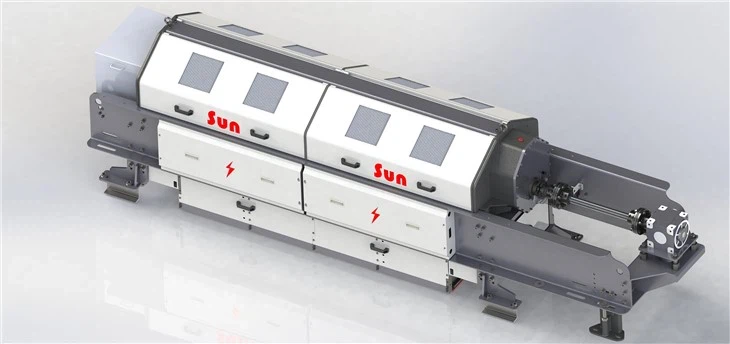
The physical size of the Chain Jacquard Machine itself is the most obvious factor influencing space requirements. Different models of Chain Jacquard Machines come in various sizes, depending on their design, the number of hooks (which determines the complexity of the patterns they can produce), and the width of the fabric they can weave.
Typically, smaller Chain Jacquard Machines designed for narrow - width fabrics may have a footprint of around 2 - 3 square meters. These machines are suitable for small - scale production or for creating specialty fabrics. On the other hand, larger machines capable of weaving wide fabrics, say up to 3 - 4 meters in width, can have a footprint of 5 - 10 square meters or more. The length of the machine also varies, with some models being relatively compact and others having a more elongated shape to accommodate the necessary mechanisms for pattern control and fabric weaving.
Clearance for Operation
In addition to the machine's actual dimensions, you need to consider the clearance space required for its operation. Operators need enough room to access the machine for maintenance, threading, and pattern - changing tasks. A general rule of thumb is to leave at least 1 - 1.5 meters of clearance around the machine on all sides. This allows operators to move freely and safely around the equipment, reducing the risk of accidents and ensuring efficient operation.
For example, if the machine has a width of 2 meters, you should plan for a total width of at least 4 - 4.5 meters to account for the clearance on both sides. Similarly, for the length, if the machine is 3 meters long, you may need a total length of 5 - 5.5 meters.
Space for Auxiliary Equipment
A Chain Jacquard Machine is often part of a larger textile production setup, and it requires auxiliary equipment to function properly. This may include warp beam stands, weft feeders, fabric take - up devices, and control panels. Each of these pieces of equipment also requires its own space.
Warp beam stands, for instance, need to be positioned in a way that allows for easy unwinding of the warp threads. Depending on the number of warp beams and their size, they can take up a significant amount of space. A set of warp beam stands for a medium - sized Chain Jacquard Machine may require an additional 2 - 3 square meters of space.
Weft feeders, which supply the weft threads to the weaving process, also need to be placed in a convenient location. They usually take up less space compared to warp beam stands, but still need to be factored into the overall space calculation.
Space for Material Storage
Textile production involves a large amount of raw materials, such as yarns, and finished products. You need to allocate space for storing these materials near the Chain Jacquard Machine. Yarn storage should be organized in a way that ensures easy access and prevents tangling. Depending on the production volume, you may need to set aside 3 - 5 square meters or more for yarn storage.
Similarly, space for storing the finished fabrics is also necessary. This space should be clean and dry to prevent damage to the fabrics. If you plan to produce a large volume of fabrics, you may need a dedicated storage area that can be several square meters in size.
Calculating the Total Space Requirements
To calculate the total space required for a Chain Jacquard Machine, you need to sum up the space occupied by the machine itself, the clearance for operation, the space for auxiliary equipment, and the space for material storage.
Let's take an example of a medium - sized Chain Jacquard Machine with a footprint of 4 square meters. Assuming a clearance of 1.2 meters on all sides, the additional clearance area around the machine would be approximately 9.6 square meters ([(4 + 2.4)×(2 + 2.4)] - 4). If the auxiliary equipment takes up 3 square meters and the material storage requires 4 square meters, the total space required would be around 20.6 square meters.

Comparing with Other Jacquard Machines
It's interesting to compare the space requirements of Chain Jacquard Machines with other types of jacquard machines. For example, the Rapier Loom with Electronic Jacquard may have different space needs. Electronic jacquard machines often have a more compact design in terms of the pattern - control mechanism, but they may require additional space for electronic components and control systems.
The Casement Jacquard Machine is another type of jacquard machine. Its space requirements can vary depending on its specific design and the type of fabrics it is intended to produce. In general, Chain Jacquard Machines may require more space for the mechanical chain - based pattern - control system compared to some modern electronic jacquard machines.
Importance of Proper Space Planning
Proper space planning for a Chain Jacquard Machine is essential for several reasons. Firstly, it ensures the safety of the operators. Adequate clearance around the machine reduces the risk of accidents, such as collisions or entanglement with moving parts.
Secondly, it improves operational efficiency. When the machine, auxiliary equipment, and material storage are well - organized, operators can move around easily and perform their tasks more quickly. This leads to higher productivity and reduced downtime.
Finally, proper space planning can also help in reducing costs. By optimizing the use of space, you can avoid unnecessary expansion of the factory, which can save on construction and rental costs.
Conclusion
In conclusion, the space requirements for a Chain Jacquard Machine depend on multiple factors, including the machine's dimensions, clearance for operation, space for auxiliary equipment, and material storage. As a supplier, I recommend that textile manufacturers carefully assess these factors before installing a Chain Jacquard Machine in their factories.
If you're considering purchasing a Chain Jacquard Machine, I encourage you to visit our website to learn more about our Chain Jacquard Machine models and their specifications. Our team of experts is also available to assist you in planning the space requirements based on your specific production needs. Whether you're a small - scale producer or a large - scale textile manufacturer, we can provide you with the right solutions to optimize your production space and enhance your productivity. Feel free to reach out to us for further discussions and to start the procurement process.
References
- Textile Machinery Handbook, various editions
- Journal of Textile Engineering, articles on jacquard machine design and operation