

As a supplier of Scarf Jacquard Machines, I'm excited to delve into the fascinating world of mechanical transmission methods used in these remarkable devices. Scarf Jacquard Machines are essential for creating intricate and beautiful patterns on scarves, and understanding their mechanical transmission is key to appreciating their functionality and efficiency.
1. Belt Transmission
One of the most common mechanical transmission methods in Scarf Jacquard Machines is belt transmission. This method involves using belts to transfer power from the motor to various components of the machine. Belts are flexible, cost - effective, and can transmit power over relatively long distances.
In a Scarf Jacquard Machine, belts are typically made of materials such as rubber or synthetic polymers. They are designed to have a high coefficient of friction to prevent slipping and ensure efficient power transfer. The belt is looped around pulleys, which are attached to the motor shaft and the shafts of other components, such as the pattern - making mechanism or the fabric - feeding system.
The advantages of belt transmission are numerous. Firstly, it is a quiet and smooth way of transmitting power, which is crucial in a production environment where noise can be a nuisance. Secondly, belts can absorb shock and vibration, protecting the machine's components from damage. However, belt transmission also has some limitations. Over time, belts can stretch and wear out, requiring regular replacement. Also, they may not be suitable for high - torque applications, as they can slip under heavy loads.
2. Chain Transmission
Chain transmission is another important mechanical transmission method used in Scarf Jacquard Machines. Chains are made up of a series of interconnected links and are used to transfer power between two or more sprockets. In a Scarf Jacquard Machine, chain transmission is often used in applications where a more positive and reliable power transfer is required compared to belt transmission.
Chains are typically made of metal, such as steel, which gives them high strength and durability. They can transmit high torques and are less likely to slip than belts. In the context of a Scarf Jacquard Machine, chain transmission is commonly used in the fabric - moving mechanism. The chain is connected to the sprockets on the drive shaft and the driven shaft, ensuring that the fabric moves at a consistent speed and with precise control.
One of the main advantages of chain transmission is its ability to operate in harsh environments. Chains can withstand high temperatures, dust, and dirt, making them suitable for industrial settings. However, chain transmission also has its drawbacks. Chains require regular lubrication to reduce friction and wear. If not properly maintained, they can become noisy and may even break, leading to machine downtime.
3. Gear Transmission
Gear transmission is a highly efficient and precise mechanical transmission method used in Scarf Jacquard Machines. Gears are toothed wheels that mesh together to transfer power and motion. In a Scarf Jacquard Machine, gear transmission is used in various critical components, such as the pattern - selection mechanism and the drive system.

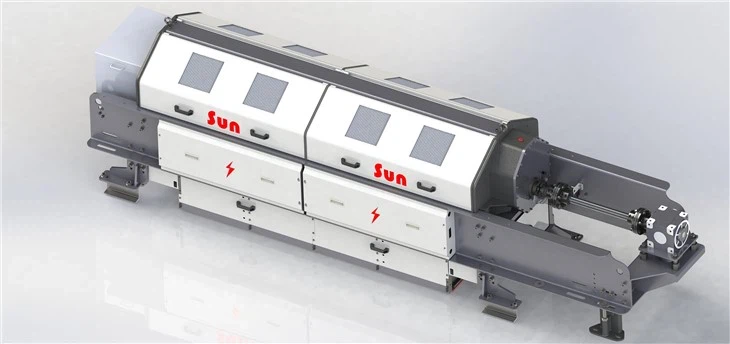
There are different types of gears used in these machines, including spur gears, helical gears, and bevel gears. Spur gears are the simplest type, with straight teeth that are parallel to the axis of rotation. They are easy to manufacture and are commonly used for low - speed applications. Helical gears, on the other hand, have teeth that are angled, which allows for smoother and quieter operation. They are suitable for high - speed and high - torque applications. Bevel gears are used to transmit power between shafts that are at an angle to each other, which is useful in the complex mechanical layout of a Scarf Jacquard Machine.
The main advantage of gear transmission is its high efficiency. Gears can transmit power with very little loss, making the machine more energy - efficient. They also provide precise control over the speed and direction of rotation, which is essential for creating accurate patterns on scarves. However, gear transmission can be expensive to manufacture and maintain. Gears need to be precisely machined to ensure proper meshing, and they require regular inspection and lubrication to prevent wear and damage.
4. Cam and Follower Transmission
Cam and follower transmission is a specialized mechanical transmission method used in Scarf Jacquard Machines for creating complex and precise movements. A cam is a rotating or sliding piece that has a specially shaped surface, and a follower is a component that follows the contour of the cam.
In a Scarf Jacquard Machine, cam and follower systems are often used in the pattern - making mechanism. The cam is designed to have a specific profile that corresponds to a particular pattern element. As the cam rotates, the follower moves up and down or side to side, controlling the movement of the warp threads to create the desired pattern.
The advantage of cam and follower transmission is its ability to generate complex and irregular motions. It allows for the creation of highly detailed and unique patterns on scarves. However, cam and follower systems are relatively complex and require precise design and manufacturing. They are also more prone to wear and tear, as the contact between the cam and the follower can be quite intense.
5. Comparison and Selection of Transmission Methods
When designing a Scarf Jacquard Machine, the selection of the appropriate mechanical transmission method depends on several factors. These include the required power, speed, precision, cost, and maintenance requirements.
For applications where smooth and quiet operation is crucial, such as in a showroom or a small - scale production environment, belt transmission may be the preferred choice. It is also suitable for applications where shock absorption is important. Chain transmission is a better option when high - torque and reliable power transfer are needed, especially in industrial settings. Gear transmission is ideal for applications that require high efficiency and precise control, such as in the pattern - selection mechanism. Cam and follower transmission is used when complex and irregular motions are required for pattern creation.
As a supplier of Scarf Jacquard Machines, we understand the importance of choosing the right transmission method for each customer's specific needs. We offer a range of Scarf Jacquard Machines that are designed with the latest mechanical transmission technologies to ensure optimal performance and reliability.
In addition to Scarf Jacquard Machines, we also supply other types of jacquard machines, such as Casement Jacquard Machines and Wall Cloth Jacquard Machines. These machines also utilize various mechanical transmission methods to achieve different functions and patterns.
If you are in the market for a Scarf Jacquard Machine or any other type of jacquard machine, we invite you to contact us for a detailed discussion. Our team of experts can help you select the most suitable machine based on your production requirements, budget, and technical specifications. We are committed to providing high - quality products and excellent customer service to ensure your satisfaction.
References
- "Mechanical Engineering Design" by Joseph E. Shigley and Charles R. Mischke
- "Textile Machinery Handbook" by various authors
- Industry reports on jacquard machine technology and development