

As a supplier of the Jacquard Module, I am often asked about the programming languages used to develop for this innovative technology. The Jacquard Module, which enables fabrics to become interactive, requires specific programming languages to bring its unique features to life. In this blog post, I'll explore the different programming languages utilized in the development process of the Jacquard Module and why they are essential.
Python: The All - Purpose Workhorse
Python is widely used in the development for the Jacquard Module. Its simplicity and readability make it an ideal choice for engineers and developers. Python has a vast library of functions and tools that can be leveraged for various tasks. For example, in data processing and analysis, Python's pandas and numpy libraries are incredibly useful. When the Jacquard Module captures data from the fabric sensors, these libraries can quickly process and make sense of the collected information.
Furthermore, Python is used for implementing machine - learning algorithms. The Jacquard Module can learn user gestures and behaviors over time. With libraries like scikit - learn, developers can train models to recognize specific patterns in the interaction data. For instance, if a user has a particular way of swiping on the Jacquard - enabled fabric, the machine - learning model can identify this gesture and trigger the corresponding action.
Python also plays a role in the development of the back - end systems that support the Jacquard Module. It can be used to build server - side applications that manage user accounts, store interaction data securely, and communicate with mobile devices. For example, the Django framework in Python can be used to create a robust and scalable web application for managing the Jacquard Module services.

JavaScript: Powering Interactivity on the Front - End
JavaScript is another crucial programming language for the Jacquard Module. In the context of front - end development, it enables seamless interaction between the user and the module. Most modern applications today are web - based or have a web component, and JavaScript is the language that makes these interfaces dynamic.
When a user connects their Jacquard - enabled fabric to a mobile device through a web browser, JavaScript is used to create the user interface. It can handle button clicks, gestures tracking on the touch screen, and real - time updates. For example, if a user taps on a virtual button on the app connected to the Jacquard Module, JavaScript code will send the appropriate command to the module and update the on - screen display accordingly.
Moreover, JavaScript is used in conjunction with Node.js to develop the middle - ware that enables communication between the Jacquard Module and other devices. Node.js is a JavaScript runtime built on Chrome's V8 JavaScript engine, and it allows developers to build server - side and networking applications using JavaScript. This is useful for creating cross - platform applications that support the Jacquard Module. For instance, a Node.js server can be used to relay data between the Jacquard Module and a cloud - based service, ensuring smooth and efficient data transfer.
C and C++: Low - Level Control and Performance
C and C++ are used for the low - level development of the Jacquard Module. They offer direct access to the hardware resources of the module, which is essential for optimizing performance and achieving real - time response.
C is known for its efficiency and speed. It is used to write the firmware of the Jacquard Module. The firmware is the software that is embedded in the hardware and controls its basic functions. It manages the operation of the sensors on the fabric, such as detecting touch, movement, and pressure. By using C, developers can ensure that the module responds quickly to user input and consumes minimal power.
C++ builds on the capabilities of C and adds object - oriented programming features. It is used for more complex tasks within the module, such as implementing algorithms for sensor fusion. Sensor fusion combines data from multiple sensors on the Jacquard - enabled fabric to provide a more accurate and comprehensive understanding of the user's actions. For example, by fusing data from a touch sensor and an accelerometer, the C++ code can better detect if a user is performing a specific gesture or movement.
Rust: A Secure and Modern Alternative
Rust is a relatively new programming language that is gaining popularity in the development of the Jacquard Module. One of the main advantages of Rust is its strong focus on memory safety and concurrency. In a device like the Jacquard Module, which may handle sensitive user data and communicate with multiple devices simultaneously, memory safety is paramount.
Rust's ownership and borrowing system prevents common programming errors such as null pointer dereferences and buffer overflows. This makes the software running on the Jacquard Module more reliable and secure. For example, when the module communicates with a mobile device over a Bluetooth connection, Rust can ensure that the data transfer is safe and that no unauthorized access can occur.
Rust also has excellent performance, similar to C and C++. It can be used in scenarios where low - level control and high - performance are required, such as in the development of the communication protocols between the Jacquard Module and other devices.
The Role of APIs and SDKs
To make it easier for developers to work with the Jacquard Module, we provide Application Programming Interfaces (APIs) and Software Development Kits (SDKs). These tools abstract away much of the complexity of working directly with the module's hardware and programming languages.
The APIs allow developers to access the functions of the Jacquard Module in a standardized way. For example, an API might provide a simple function call to retrieve the current sensor data from the module. This reduces the amount of code that developers need to write and ensures compatibility across different versions of the module.
The SDKs, on the other hand, come with sample code, documentation, and tools to help developers get started quickly. They are designed to work with the programming languages mentioned above, providing a convenient way to integrate the Jacquard Module into various applications. For instance, an SDK might include JavaScript libraries that can be easily imported into a web application to enable communication with the Jacquard Module.
Our Products and Their Features
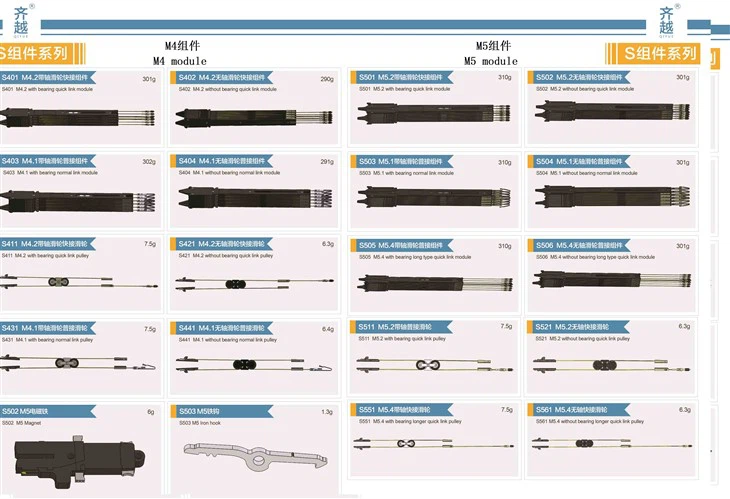
As a supplier of the Jacquard Module, we offer a range of related products. The M5.2 Without Bearing Quick Link Pulley is a key component that enables smooth and efficient operation of the Jacquard - enabled fabric. It is designed to withstand high - frequency usage and provides a durable connection between different parts of the fabric.
The M5 Magnet is another important product. It plays a role in the attachment and alignment of different fabric components. Its strong magnetic force ensures a secure connection, and it is also important for maintaining the proper functionality of the sensors on the fabric.
The Reset Key is a simple yet essential tool. In case there are any issues with the Jacquard Module, such as a software glitch or a connection problem, the reset key can be used to restore the module to its default settings quickly and easily.
Contact Us for Procurement
If you are interested in purchasing our Jacquard Module or any of the related products, we encourage you to get in touch with us for procurement and further discussions. Our team of experts is ready to assist you in integrating the Jacquard Module into your products and projects. Whether you are a large - scale manufacturer, a startup, or an individual developer, we have the products and the support you need.
References
- Python Foundation. (2023). Python Documentation.
- Mozilla Developer Network. (2023). JavaScript Documentation.
- ISO/IEC 9899:2018. (2018). Information technology — Programming languages — C.
- ISO/IEC 14882:2020. (2020). Information technology — Programming languages — C++.
- Rust Foundation. (2023). Rust Programming Language Documentation.